


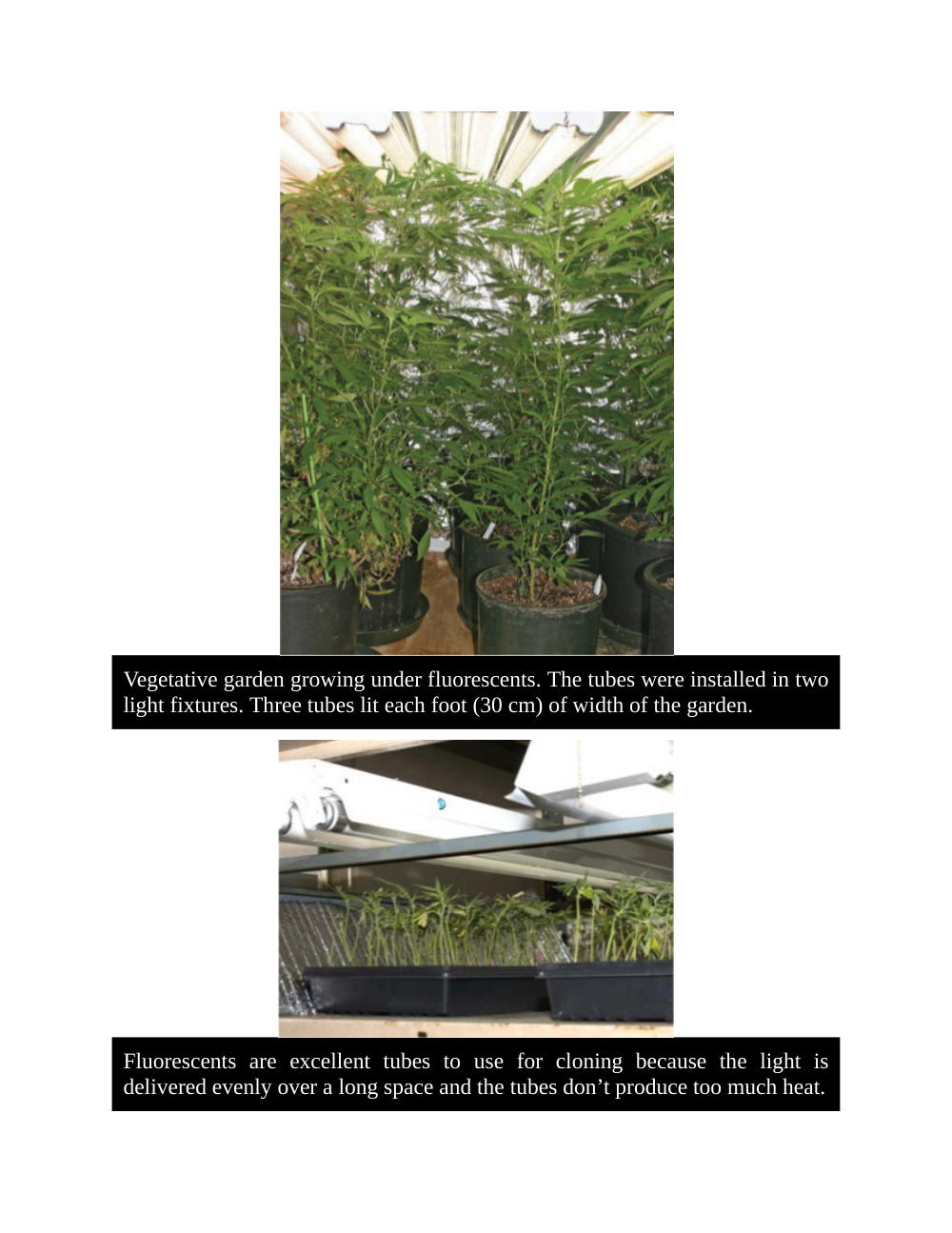
Where fluorescents fit

Strengths
Cheap, easy, fairly efficient, even over a long strip, and cool enough for clones
Limit
They do not match HPS intensity, so buds are usually smaller and looser
Skip household floods
Incandescent and quartz halogen turn only about 10-20% of power into light. Use a CFL or LED for a dark corner
Veg dose
At least 30 W of fluorescent per square foot; 40-60 W/sq ft grows faster and bushier if other needs are met
Mix sources
Side-mount tubes or hang work lights in the rows to fill HID shadows. Mid-garden tubes need no reflector
Tube sizes
T number
The number is eighths of an inch. T-5 is 5/8 in, T-8 is 1 in, T-12 is 1.5 in
T-12
Least efficient and hard to pack tightly
T-8
About 8 W per linear foot and 650-700 lumens per foot; about 15% more light per watt than T-12
T-8 packing
Hard to fit more than three or four tubes per foot once reflectors are on. Best for clones and side light
HO T-8
About 12-14 W per square foot and 1,000-1,250 lumens per foot
T-5
About 30% more light per watt than T-8 and thin enough to run four tubes per foot of width
T-5 HO numbers
One tube
A 4 ft HO T-5 uses 54 W and emits roughly 5,000 lumens, about twice a standard T-5
Bank
Eight 4 ft HO tubes emit about 40,000 lumens on about 435 W
Versus 400 W HPS
That HPS draws about 440 W and makes about 50,000 lumens
4×4 footprint
That T-5 bank over 16 sq ft is about 2,500 foot-candles
Power cost
T-5 HO uses about 60% more electricity than regular T-5s
Spectrum, CFLs, and distance
Cool white
More blue. Favors stout vegetative stems
Warm white
More red. Used in flower because red supports bloom
Plant-growth tubes
Heavy red/blue, less total light
CFL habit
Built-in ballast, screw base, point source. Group them. Base-up is brightest; horizontal is weakest. Use a bowl reflector
CFL sizes
Common large lamps run 25, 50, 100, 150, 200, and 250 W
Distance
Keep fluorescent and LED lamps about 2-10 inches from tops. Do not let leaves touch or they burn