


Why distance looks dimmer

Spread, not loss: A focused beam stays intense. A wide flood dilutes the same photons over more plants.

Footprint trade: Lighting a larger area always lowers intensity at each leaf.

Wasted rays: Any photon that hits ceiling, wall, or floor is paid for and unused.

HID and fluorescent habit: Those lamps emit in all directions, so a reflector is not optional.
Fluorescent and CFL reflectors

Crowded tubes
Fixtures that pack tubes tight can trap about 40% of the light between tubes and the housing
Baffles
Mini-reflectors between tubes bounce light down instead of tube-to-tube
CFL bowls
Clamp-on bowl reflectors, or a commercial hood on large CFLs, can roughly double canopy intensity
Buy the hood
A better reflector pays back in yield faster than adding another weak fixture
HID hood orientation
Side emission
MH and HPS throw most light out the sides of the arc tube
Horizontal
Preferred in most gardens because more light starts aimed at the canopy
Focused hoods
Best for one- or two-lamp rooms so light does not spill off the sides
Wide hoods
Better in the center of a large room so plants get light from several angles and fewer shadows
Perimeter
Keep edge hoods tight so light stays in the garden
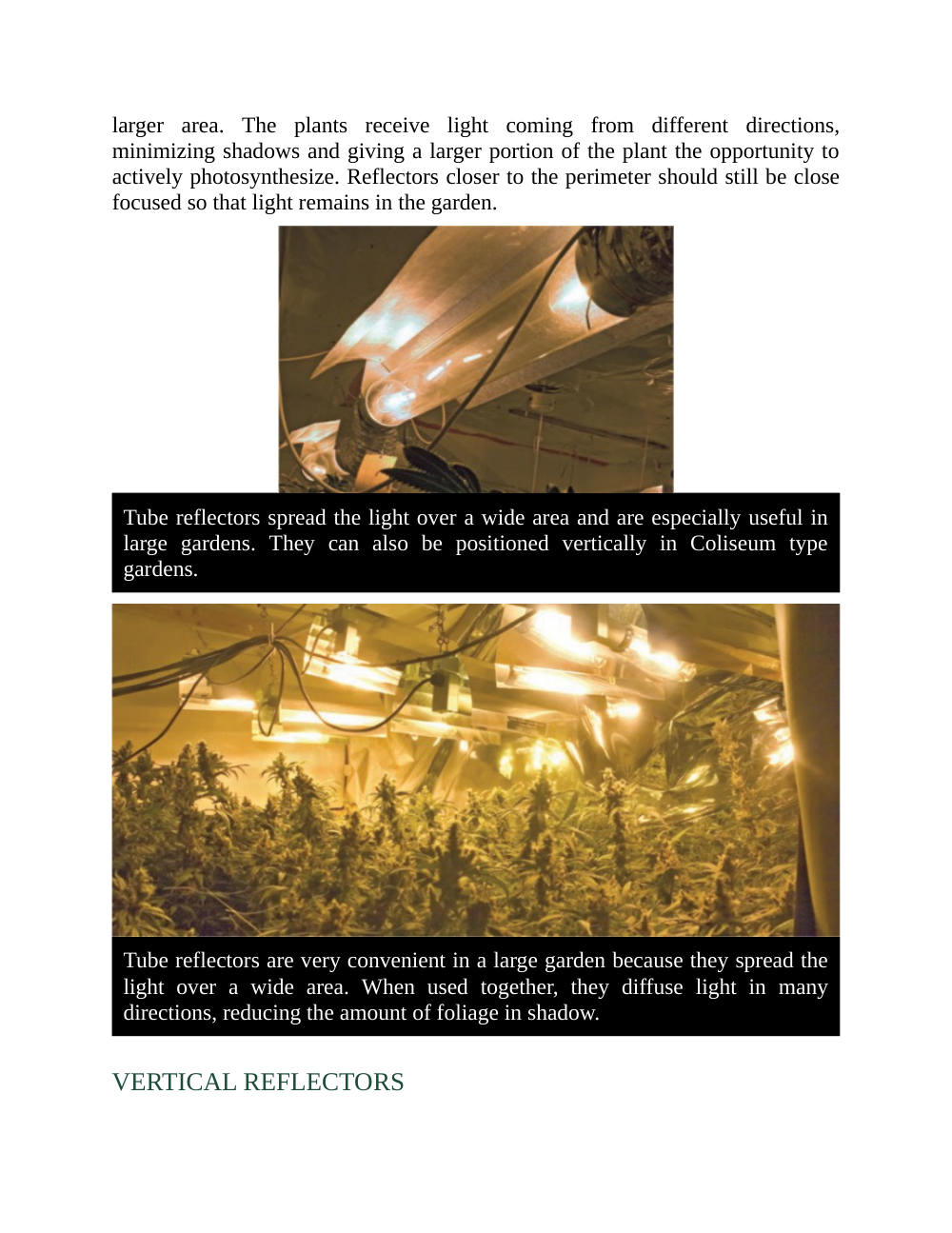
Tube hoods
Spread light over a wide area and can hang vertically in a coliseum-style ring
Vertical hoods
Path
A vertical bulb sends almost all light sideways at the walls
Shallow dishes
Many commercial vertical reflectors are too shallow and dump light in a huge circle
Adjustable sockets
Help a little but do not fix a shallow shape
Verdict in the book
Vertical reflectors are inefficient at putting light on plants